
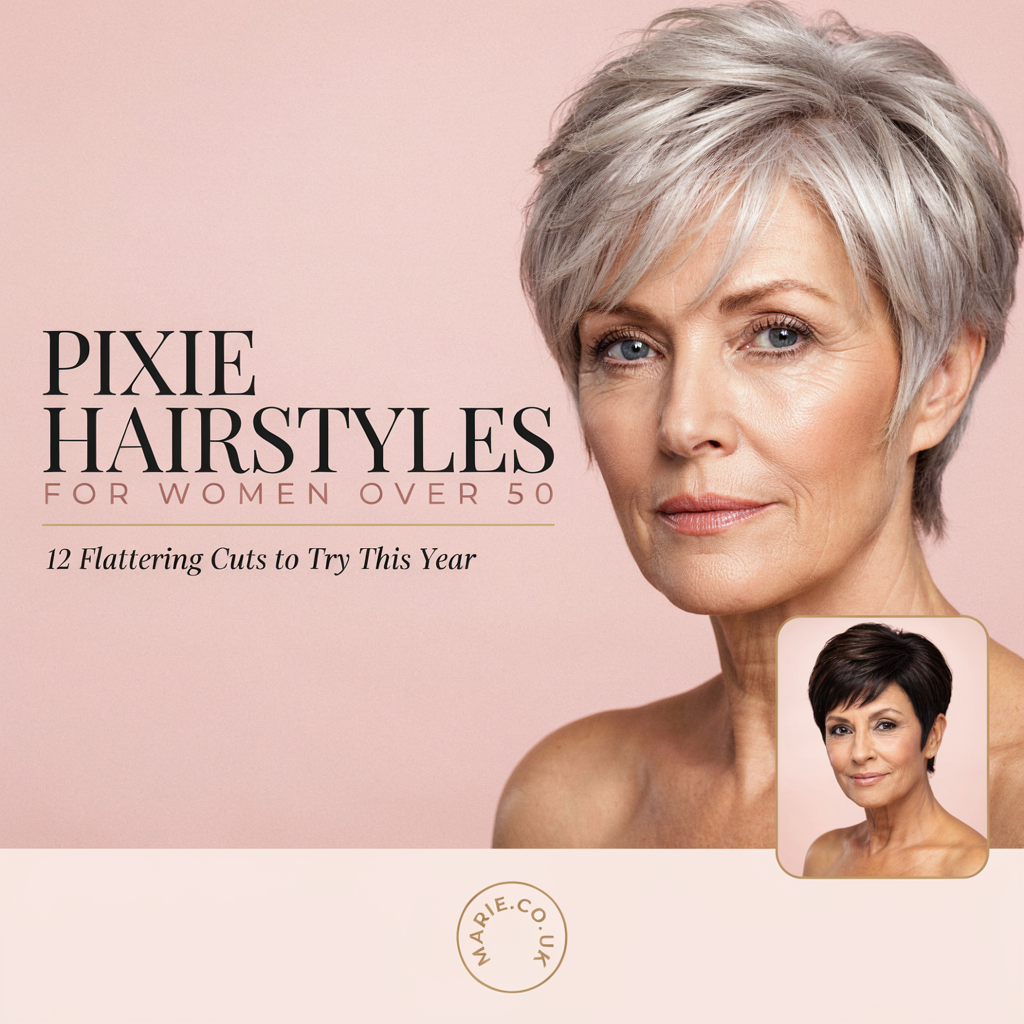
A great haircut can make getting ready easier while helping your natural features take centre stage. For women over 50, the pixie remains one of the most versatile short hairstyles because it can be adapted to different hair textures, face shapes and levels of maintenance.
From soft layered pixies and naturally curly styles to elegant silver cuts and modern tapered looks, pixie hairstyles for women over 50 don’t have to mean one particular haircut.
The key is finding the right balance of length, texture and shape for your hair.
If you have naturally curly or wavy hair, you may also want to explore our complete guide to Short Curly Pixie Hairstyles, where we cover different pixie styles, face shapes, styling and maintenance in more detail.
Why Are Pixie Hairstyles So Popular with Women Over 50?
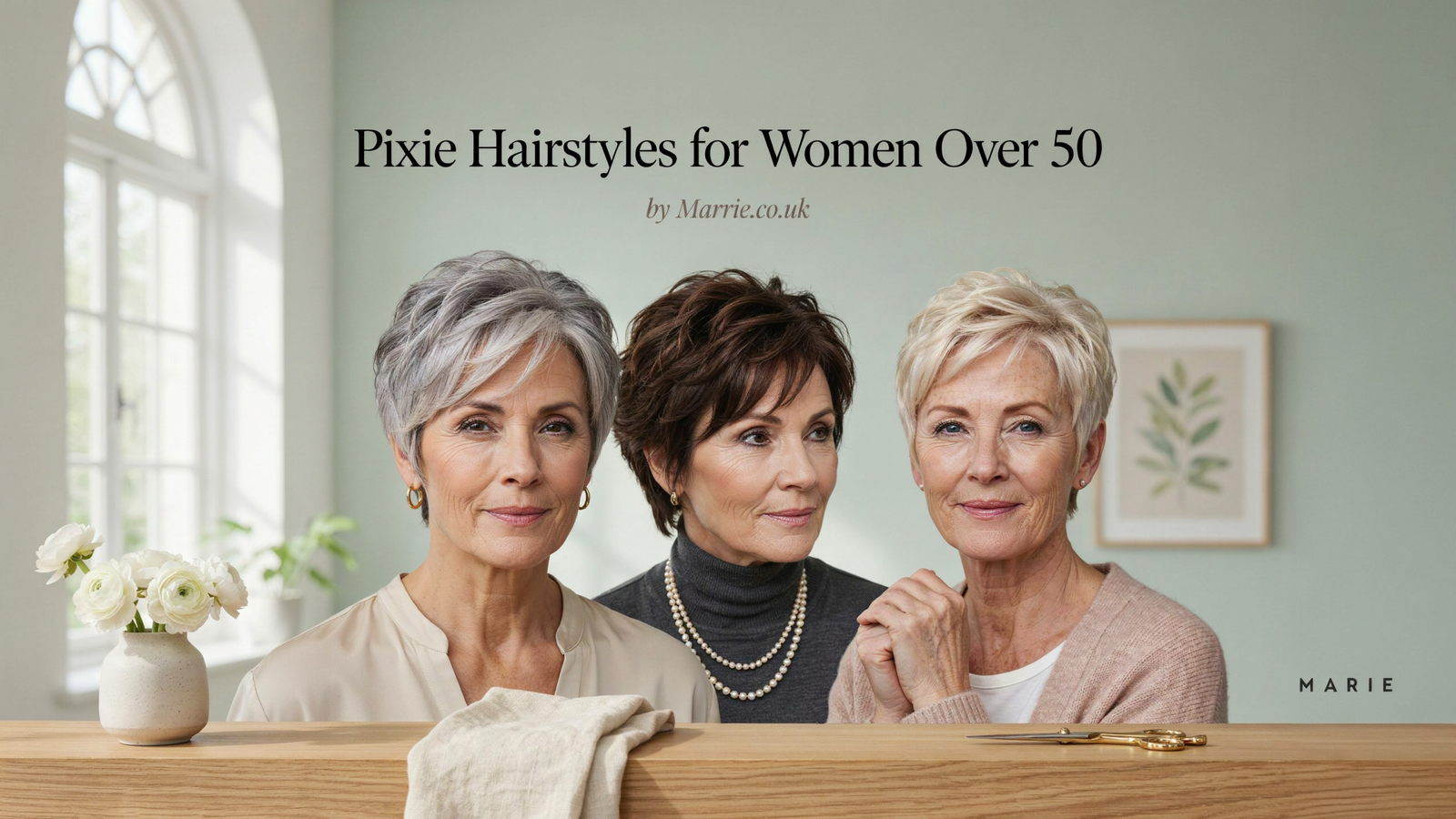
One reason pixie cuts work particularly well later in life is their adaptability.
Hair can change in density, texture and behaviour over time. Some women notice finer strands, while others continue to have very thick or naturally curly hair. A well-designed pixie can work with those characteristics rather than fighting against them.
A pixie can also:
- Make daily styling quicker
- Remove dry or damaged lengths
- Give fine hair the appearance of greater fullness
- Make natural curls easier to shape
- Highlight the eyes, cheekbones and jawline
- Work beautifully with grey and silver hair
- Be customised from soft and feminine to bold and contemporary
The important point is that shorter doesn’t automatically mean lower maintenance. A pixie generally requires less daily styling than many longer cuts, but keeping its shape usually means more frequent salon trims.
21 Pixie Hairstyles for Women Over 50
1. Soft Layered Pixie
A soft layered pixie is an excellent starting point if you want short hair without an extremely cropped appearance.
Rather than creating harsh lines, the stylist uses layers to build movement through the crown and around the face.
This works particularly well for women who want something elegant and versatile.
Best for: Fine to medium hair
Works well with: Oval, heart and longer faces
Styling level: Easy
2. Curly Pixie for Women Over 50
Natural curls can give a pixie wonderful shape and personality.
Keeping slightly more length through the top allows curls to form properly, while shorter sides prevent the hairstyle from becoming too wide.
Avoid cutting curly hair unnecessarily short at the crown because curl shrinkage can make the finished style considerably shorter than expected.
Best for: Naturally curly hair
Styling tip: Use a lightweight curl cream rather than heavy wax.
3. Silver Pixie Cut
Grey doesn’t need to be hidden.
A well-shaped silver pixie can make natural grey, white and silver tones an intentional part of the hairstyle.
Subtle layering can also reveal the different tones naturally present in grey hair, creating dimension without requiring additional colour.
Best for: Naturally grey or silver hair
Styling level: Low to moderate
4. Pixie with Side-Swept Bangs
If you’re hesitant about exposing the entire forehead, consider keeping the front longer.
Side-swept bangs soften the transition into short hair while creating movement across the face.
They also give you more styling flexibility than an ultra-short fringe.
Best for: Most hair textures
Particularly flattering for: Round, square and heart-shaped faces
5. Tapered Curly Pixie
A tapered pixie gradually becomes shorter around the sides and nape while maintaining texture and volume on top.
It’s especially effective on naturally curly and coily hair because it creates a defined silhouette without removing the character of the natural texture.
Best for: Curly and coily textures
Maintenance: Regular shaping is important.
6. Voluminous Pixie for Fine Hair
Going shorter can sometimes help fine hair appear fuller because long lengths are no longer pulling the hair down.
Strategic layers through the crown can provide additional lift.
However, excessive layering can have the opposite effect by removing too much density. For fine hair, the cut needs to preserve enough weight to maintain fullness.
Best for: Fine or thinning hair
Styling tip: Try lightweight volumising mousse at the roots.
7. Textured Pixie Cut
A textured pixie has a slightly more relaxed finish than a traditional polished pixie.
Instead of every strand sitting perfectly in place, small sections are separated to create definition and movement.
This is an excellent choice if you prefer contemporary, effortless-looking hairstyles.
Best for: Straight, wavy and slightly curly hair
8. Long Pixie Cut
Not ready for a very short haircut?
A long pixie retains additional length through the top, sides or fringe while keeping the characteristic cropped shape at the back.
It can be a particularly good transition haircut when moving from a bob to something shorter.
Best for: First-time pixie wearers
9. Classic Short Pixie
Simple doesn’t mean outdated.
A traditional short pixie keeps the sides neat with slightly more length through the crown.
The result is clean and understated, making it suitable for women who don’t want to spend much time styling their hair each morning.
Best for: Straight to softly wavy hair
10. Wavy Pixie
Natural waves add softness to short hairstyles.
Rather than straightening the texture, leaving enough length on top allows the wave pattern to create natural movement.
A little styling cream or mousse may be all that’s needed.
Best for: Type 2/wavy hair
11. Feathered Pixie
Feathered layers create light movement around the crown and sides.
The style can be especially useful when you want softness rather than the sharper structure of a cropped or tapered pixie.
A side fringe can complete the look.
Best for: Fine to medium hair
12. Pixie with Longer Crown
Keeping the crown longer gives you more control over volume.
You can wear it softly swept to one side, textured, curled or lifted slightly at the roots.
It also provides useful styling flexibility between salon appointments.
Best for: Fine, medium and thick hair
13. Pixie for Thick Hair
Thick hair can work extremely well with a pixie, provided the cut manages bulk carefully.
Internal layering can remove excess weight while retaining the visible shape of the hairstyle.
The objective isn’t simply to thin the hair aggressively; it’s to distribute the volume where it complements the haircut.
Best for: Dense and thick hair
If this describes your hair, see our dedicated guide to Pixie Hairstyles for Thick Hair for more ideas.
14. Pixie with Wispy Fringe
A light, wispy fringe can soften a short haircut without creating the heaviness of full bangs.
It can be swept sideways or worn loosely over the forehead.
Best for: Fine to medium hair
Good choice for: Softening angular facial features
15. Curly Pixie with Longer Top
Instead of cutting curls uniformly short, leave extra length through the crown.
This allows the curl pattern to become a central feature of the haircut.
The shorter sides create contrast while keeping the overall silhouette manageable.
Best for: Type 3 curls
16. Side-Parted Pixie
Sometimes a small styling change can transform a simple haircut.
A defined side part creates asymmetry and gives the hair direction, making even a relatively classic pixie feel polished.
It can also work particularly well with a longer fringe.
Best for: Straight, wavy and loose curly textures
17. Tousled Pixie
A tousled pixie embraces movement rather than precision.
A small amount of lightweight styling product can be worked through the hair with your fingers to separate sections.
The result should look relaxed rather than deliberately messy.
Best for: Wavy and textured hair
18. Short Coily Pixie
Coily hair doesn’t need to be straightened to wear a pixie.
A short natural cut can showcase the curl pattern while keeping styling relatively straightforward.
Moisture is especially important, so choose products designed to hydrate without creating excessive buildup.
Best for: Type 4/coily hair
19. Pixie with Soft Face-Framing Layers
Leaving subtle length around the temples or fringe can create a softer outline around the face.
This can be useful if you like the practicality of short hair but don’t want a highly exposed or sharply cropped finish.
Best for: Most face shapes
20. Brushed-Back Pixie
Keeping the front slightly longer allows it to be swept backwards for an elegant, open style.
Rather than creating extreme height, aim for gentle lift at the roots.
This can be particularly effective for evenings or occasions when you want a more polished version of your everyday pixie.
Best for: Medium-density hair
21. Low-Maintenance Natural Pixie
One of the easiest approaches is simply to design the haircut around the way your hair naturally behaves.
If your hair curls, let it curl. If it has a natural wave, build the shape around that movement.
A stylist who understands your texture can create a cut that requires considerably less daily manipulation.
Best Pixie Cut for Women Over 50 by Hair Type
| Hair Type | Pixie Style to Consider | Why |
|---|---|---|
| Fine hair | Layered or volumised pixie | Can create the appearance of fullness |
| Thick hair | Textured or tapered pixie | Helps manage bulk |
| Curly hair | Curly pixie with longer crown | Preserves curl definition |
| Wavy hair | Tousled or layered pixie | Works with natural movement |
| Coily hair | Tapered natural pixie | Creates shape while celebrating texture |
| Straight hair | Classic or side-parted pixie | Creates a clean silhouette |
| Grey hair | Silver textured pixie | Highlights natural tonal variation |
Choosing a Pixie Hairstyle for Your Face Shape
Hair texture shouldn’t be your only consideration. The placement of volume, fringe and length can alter how a pixie frames your face.
Round Face
Consider keeping some height or volume at the crown while avoiding excessive width at the sides.
A longer side-swept fringe can also introduce diagonal lines that visually lengthen the face.
Oval Face
Oval faces can usually accommodate a wide range of pixie styles, from short crops to curly and longer pixies.
This gives you more freedom to choose primarily according to hair texture and personal preference.
Square Face
Soft texture, waves and wispy fringes can contrast nicely with a defined jawline.
If you want a softer overall effect, avoid making every edge of the haircut extremely sharp.
Heart-Shaped Face
Side-swept bangs and slightly fuller sides can help create balance between a wider forehead and narrower chin.
Long Face
Be cautious about creating excessive vertical height at the crown.
A fringe or some width around the sides can help create more balanced proportions.
Pixie Hairstyles for Women Over 50 with Fine Hair
Fine hair deserves particular attention because simply cutting it short doesn’t guarantee more volume.
The goal should be to create visual density.
Ask your stylist about preserving weight where the hair is naturally thinner while using controlled layering to create movement.
For styling, lightweight products are generally preferable. Heavy oils, waxes and creams can make fine hair collapse.
We’ve created a separate Pixie Hairstyles for Fine Hair guide for readers who want to explore this subject in greater detail.
Pixie Hairstyles for Women Over 50 with Thick Hair
With thick hair, the challenge is almost the opposite.
You already have plenty of density, so the haircut needs to control where that volume sits.
A tapered nape, carefully shaped sides and internal layering can reduce unnecessary bulk without making the hair look thin.
This is also why copying a photograph without considering your own hair density can produce disappointing results. The same pixie can behave completely differently on fine and thick hair.
What About Grey Hair?
A pixie can be an excellent haircut for transitioning to natural grey.
Because more of the previously coloured length is gradually removed during regular trims, the transition may become easier to manage.
Grey hair isn’t one universal texture, though. Some people notice that individual grey strands feel coarser or behave differently from their pigmented hair.
Adjust your conditioner and styling routine according to how your hair actually feels, rather than assuming grey hair always requires a particular product.
How to Style a Pixie Cut at Home
A complicated daily routine shouldn’t be necessary for a well-cut pixie.
After washing, gently remove excess water without aggressively rubbing the hair. Apply a small amount of styling product appropriate for your texture.
For curly hair, scrunch in curl cream or gel and allow curls to form naturally or use a diffuser.
For fine hair, apply lightweight volumising product near the roots and dry while directing the hair into the desired shape.
For textured pixies, use a very small amount of styling cream or paste after drying to separate individual sections.
Remember: with short hair, a little product goes a long way.
How Often Should Women Over 50 Trim a Pixie?
Most pixies benefit from reshaping roughly every 4–8 weeks, depending on how short and structured the haircut is and how quickly your hair grows.
A very neat tapered pixie may start losing its silhouette sooner, while a longer layered pixie can usually tolerate more growth.
Don’t automatically book according to a fixed rule. Watch what happens to the shape of your haircut.
If the sides begin feeling bulky, the neckline loses definition or the crown becomes difficult to style, it may be time for a trim.
What to Tell Your Hairstylist
Don’t simply walk into the salon and ask for “a pixie.”
That leaves a lot open to interpretation.
Bring two or three reference photographs and discuss:
- How short you’re comfortable going
- How much length you want around the ears
- Whether you want your forehead exposed
- Your natural hair texture
- How your hair behaves when air-dried
- Areas where your hair is particularly fine or thick
- How much time you’re prepared to spend styling
- Whether you’re willing to visit regularly for trims
Also show the stylist your hair in its normal state whenever possible.
A haircut that looks fantastic after a professional blow-dry isn’t necessarily the right haircut if you never style your hair that way at home.
Things to Consider Before Getting Your Next Pixie Cut
Before making the change, think beyond the photograph you’ve saved.
Consider your natural texture. A straight pixie and curly pixie require very different cutting approaches.
Think about maintenance. Less hair doesn’t necessarily mean fewer salon appointments.
Discuss shrinkage if your hair curls. Your finished dry length may be considerably shorter than it appears when wet.
Don’t ignore your lifestyle. Your haircut should work on ordinary mornings, not just after a salon appointment.
Consider the grow-out. If you regularly switch between short and longer hairstyles, leaving slightly more length can make future transitions easier.
Accessories and Short Pixie Hair
Having short hair doesn’t mean abandoning hair accessories.
Depending on the length of your pixie, small clips, pins, headbands and decorative accessories can help control longer fringe sections or simply change the appearance of the hairstyle.
The important thing is scale. Large claw clips designed for thick, long hair generally aren’t suitable for a very short pixie.
Instead, look for smaller hair clips and accessories that can grip shorter sections without overwhelming the hairstyle.
This also gives us a natural commercial link from Marrie’s hairstyle content into the appropriate hair-accessory collection without forcing products into the article.
Frequently Asked Questions
Is a pixie cut flattering for women over 50?
It certainly can be. The best result depends less on age and more on choosing a shape that works with your face, hair texture, density and personal style.
What is the best pixie cut for a woman over 50?
There isn’t one universal best style. Soft layered pixies are versatile, while tapered pixies can work beautifully for curly hair and carefully layered cuts can help fine hair appear fuller.
Do pixie cuts make you look younger?
No haircut can guarantee a younger appearance. However, a well-shaped pixie can create a fresh, contemporary look and highlight facial features.
Are pixie cuts good for thinning hair?
They can be. Removing excess length may prevent fine hair from looking weighed down, while carefully positioned layers can create more apparent volume. Excessive thinning should generally be avoided on already fine hair.
What pixie haircut is best for thick hair over 50?
Textured, tapered and layered pixies can all work well because they allow a stylist to manage excess bulk while retaining shape.
Can women over 50 with curly hair wear a pixie?
Absolutely. Natural curls can add volume, movement and personality to a pixie. Keeping enough length for the curl pattern to form is important.
Does a pixie cut work with glasses?
Yes. Consider how the sideburn area, fringe and hair around the ears interact with your frames. Bringing your everyday glasses to the salon can help your stylist assess the overall proportions.
Is a pixie haircut high maintenance?
Daily styling can be relatively simple, but maintaining a precise short shape generally requires regular trims.
How often should a pixie cut be trimmed?
Approximately every 4–8 weeks is common, although the right schedule depends on your haircut, growth rate and how neat you want the shape to remain.
Can I wear a pixie with naturally grey hair?
Yes. Grey, white and silver hair can look particularly striking with a defined short shape, and textured pixies can showcase natural variations in colour beautifully.
Final Thoughts
The best pixie hairstyles for women over 50 aren’t about following rules for a particular age. They’re about choosing a haircut that suits the hair you have today.
Fine hair may benefit from carefully placed volume. Thick hair may need strategic weight removal. Curls often look best when given enough length to form naturally, while grey and silver shades can become a defining feature rather than something to conceal.
Start with your hair texture, density, face shape and everyday routine, then choose the pixie style that fits those characteristics.
And if curly texture is an important part of your decision, continue with our complete guide to Short Curly Pixie Hairstyles for more haircut ideas, maintenance advice and styling inspiration.