
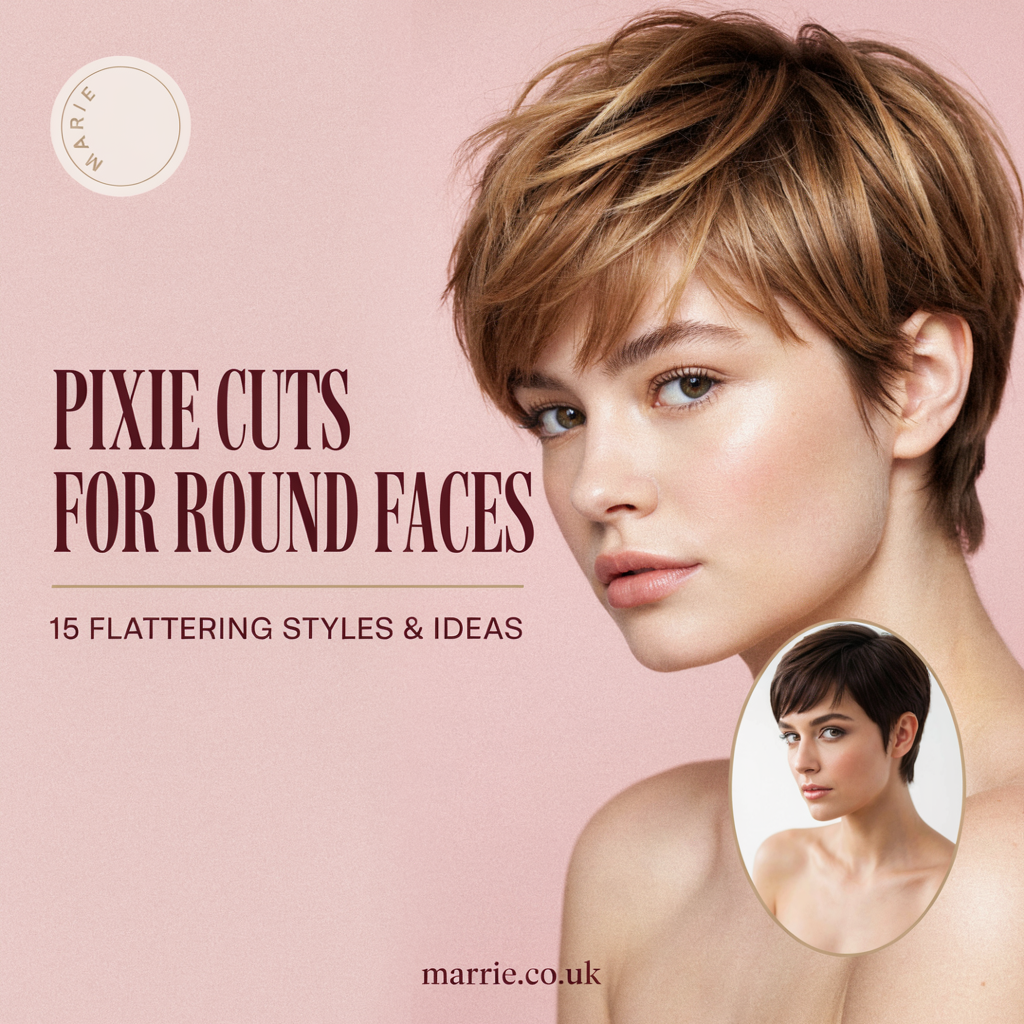
A round face can look fantastic with a pixie cut. The key is not simply choosing a short hairstyle, but choosing the right shape, length, texture and volume placement.
Some people with round faces avoid pixie cuts because they worry that short hair will make their face appear wider. In reality, a well-designed pixie can do the opposite. Extra height through the crown, tapered sides, an asymmetric fringe or carefully placed curls can visually lengthen the face while highlighting the eyes and cheekbones.
Whether your hair is curly, wavy, straight, fine or thick, there are plenty of ways to adapt a pixie to complement a rounder face shape.
If you are exploring curly variations in particular, visit our complete guide to Short Curly Pixie Hairstyles for more ideas, styling advice and pixie inspiration.
Pixie Cut for Round Faces
Is a Pixie Cut Good for a Round Face?
Yes. A pixie cut can be extremely flattering on a round face when the haircut creates the right proportions.
Round faces typically have softer curves, with the width and length of the face being relatively similar. The cheeks are often the widest area, while the jawline tends to be softer rather than sharply angular.
For this reason, pixie styles that create vertical height, definition and slight asymmetry can work particularly well.
Features worth considering include:
- Extra volume at the crown
- Shorter or tapered sides
- Longer layers on top
- Side-swept bangs
- Asymmetric fringes
- Defined curls rather than excessive width
- Deep side parts
- Texture concentrated toward the top of the head
There is no rule saying that someone with a round face must make it look slimmer. These techniques are simply useful if you want your haircut to create a more elongated or defined appearance.
15 Best Pixie Cuts for Round Faces
1. Voluminous Pixie with Height on Top
One of the easiest ways to complement a round face is to add volume vertically rather than horizontally.
Keeping the sides relatively neat while allowing longer layers through the crown creates height and can make the overall silhouette appear longer.
This works particularly well for naturally thick or curly hair because the texture already provides plenty of lift.
Best for: Thick, curly or naturally voluminous hair.
Styling tip: Apply a lightweight mousse at the roots and direct the hair upward while drying.
2. Curly Pixie with Tapered Sides
A tapered curly pixie combines two features that work beautifully together.
The shorter sides keep the hairstyle neat around the cheeks, while curls through the crown provide texture and height.
Rather than removing your natural curl pattern, the haircut uses it to create shape.
If you love naturally textured short hairstyles, you can find many more variations in our Short Curly Pixie Hairstyles guide.
Best for: Naturally curly and coily hair.
3. Side-Swept Pixie Cut
A long side-swept fringe introduces a diagonal line across the face, which can help break up the symmetry associated with a round face.
This is also an excellent option if you are nervous about going very short because some length remains around the front.
The fringe can be styled softly for an everyday look or given more definition for evenings and special occasions.
Best for: Straight, wavy and loosely curled hair.
4. Asymmetrical Pixie for a Round Face
An asymmetrical pixie keeps one side noticeably longer than the other.
That uneven shape adds visual interest while drawing attention away from the widest part of the face.
A longer fringe sweeping across the forehead can make the effect even stronger.
This is one of the better choices if you want your pixie to feel modern and slightly edgy rather than traditionally feminine.
Best for: Women wanting a contemporary statement haircut.
5. Pixie with Long Side Bangs
You don’t necessarily need to choose between bangs and a flattering round-face haircut.
Long bangs swept towards one side can frame the face beautifully without creating a heavy horizontal line across the forehead.
They can also be tucked behind the ear when you want a cleaner appearance.
If you’re considering different fringe styles, read our dedicated guide to Pixie with Bangs through the main pixie hairstyle hub.
Best for: Anyone who wants softness around the forehead.
6. Textured Pixie with Choppy Layers
Choppy layers can transform a simple pixie.
Instead of creating one smooth, rounded silhouette, individual layers introduce different directions and dimensions.
Concentrate most of the texture through the top and front rather than adding too much bulk directly beside the cheeks.
A small amount of styling wax or texturising cream can help separate individual pieces.
Best for: Straight to slightly wavy hair.
7. Curly Pixie with Side Part
A deep side part is a small adjustment that can have a surprisingly significant effect.
Moving the part away from the centre creates asymmetry and allows curls to fall naturally towards one side.
For round faces, try maintaining some height through the heavier side rather than allowing the curls to spread entirely outward.
Best for: Type 2 and Type 3 curls.
8. Pixie with a Lifted Front
Think of this as a softer version of a quiff.
The front section is styled upward and slightly backwards, creating height above the forehead.
It can be particularly effective for round faces because the eye follows the upward direction of the hairstyle.
You don’t need dramatic volume. Even a subtle lift can change the proportions of the cut.
Best for: Fine to medium hair.
9. Short Tapered Pixie
A classic tapered pixie gradually becomes shorter around the ears and nape while retaining additional length through the top.
The clean sides expose more of the face and neck, while the longer crown provides styling flexibility.
It’s also relatively easy to manage day-to-day.
Best for: Someone wanting a polished, practical short haircut.
10. Pixie with Wispy Bangs
If you prefer bangs but don’t want a heavy fringe, consider soft, wispy pieces.
Unlike a thick straight-across fringe, wispy bangs allow some forehead to remain visible and create a lighter appearance.
Ask your stylist to blend the fringe naturally into the surrounding layers.
Best for: Fine or medium hair.
11. Messy Curly Pixie
Not every pixie needs to look perfectly sculpted.
A deliberately tousled curly pixie creates movement and personality while making natural texture the focus.
Keep some height around the crown and avoid allowing all the volume to sit directly beside the cheeks.
Use your fingers rather than repeatedly brushing the curls once they have dried.
Best for: Natural curls and waves.
12. Pixie with Short Sides and Long Top
The contrast between short sides and a longer top creates a strong vertical silhouette.
You can wear the top curly, tousled, swept sideways or lifted depending on the occasion.
This also gives you more styling possibilities than an ultra-short pixie.
Best for: Medium to thick hair.
13. Soft Pixie for Fine Hair and Round Faces
Fine hair doesn’t mean a pixie has to sit completely flat.
Strategically placed shorter layers can create the appearance of fullness without requiring heavy styling products.
Keep some length through the crown and consider a side fringe to introduce movement.
Our separate Pixie for Fine Hair guide goes into much more detail on choosing a short haircut when volume is limited.
Best for: Fine, soft or naturally straight hair.
14. Layered Pixie for Thick Hair
Thick hair gives you plenty of material to create a beautifully structured pixie, but removing bulk in the correct areas matters.
Too much width around the sides can exaggerate the roundness of the silhouette.
Instead, your stylist can remove unnecessary weight while retaining enough length on top to show off your hair’s natural body.
For more ideas, explore our dedicated Pixie for Thick Hair guide.
Best for: Dense, coarse or naturally voluminous hair.
15. Silver or Grey Pixie for Round Faces
A beautifully shaped pixie can be an excellent way to showcase natural grey or silver hair.
Consider a softly tapered base combined with textured layers or curls through the crown.
The result can look sophisticated without requiring an elaborate daily routine.
For mature hairstyle inspiration, our Pixie for Women Over 50 guide explores more short-hair options.
Best for: Grey, silver or transitioning hair.
Which Pixie Style Works Best for Your Hair Type?
Your face shape is only one part of choosing a haircut. Hair density and texture matter just as much.
| Hair Type | Pixie Style to Consider |
|---|---|
| Fine hair | Layered pixie with crown volume |
| Thick hair | Tapered or undercut pixie |
| Curly hair | Tapered curly pixie |
| Wavy hair | Tousled side-swept pixie |
| Coily hair | Short tapered pixie with defined top |
| Straight hair | Asymmetrical or choppy pixie |
| Mature/grey hair | Soft layered or textured pixie |
Use these as starting points rather than strict rules. A good stylist can modify almost any pixie to suit your particular texture and density.
How to Make a Pixie Cut Flatter a Round Face
The secret is often where the volume sits.
Add height at the crown
Volume through the top visually increases the vertical dimension of the hairstyle.
Keep the sides more controlled
If your aim is to create a longer-looking silhouette, avoid concentrating excessive volume directly beside the cheeks.
Experiment with asymmetry
Side parts, sweeping fringes and uneven lengths interrupt a perfectly rounded outline.
Don’t automatically avoid bangs
Bangs can work extremely well. Side-swept, wispy and asymmetrical fringes are particularly versatile.
Work with your natural texture
Don’t choose a photograph of straight hair if maintaining that appearance would require you to straighten tight curls every morning.
The most successful haircut is one you can realistically maintain.
Pixie Cuts for Round Faces with Curly Hair
Curly hair and round faces are a particularly good combination for pixie cuts because curls make it easy to create dimension.
The important consideration is curl placement.
Rather than building maximum width at cheek level, consider keeping the sides slightly more controlled and allowing your natural curls to create height through the crown.
Good options include:
- Tapered curly pixie
- Side-parted curly pixie
- High-top curly pixie
- Curly pixie with long bangs
- Short sides with defined curls on top
- Tousled curly pixie
For a much larger collection, see our main Short Curly Pixie Hairstyles: The Ultimate Guide.
How to Style a Pixie Cut for a Round Face
You don’t need an extensive routine.
Start with damp hair and apply a lightweight product suited to your texture.
For curly hair, try curl cream or mousse. For fine or straight hair, a volumising mousse or root-lifting product may be more appropriate.
Concentrate on creating lift around the crown.
If you’re blow-drying, direct the top upward or slightly backwards. Curly hair can be dried with a diffuser to preserve definition.
Finish by shaping the fringe or front section with your fingers.
Avoid applying excessive waxes, oils and heavy creams around the roots because they can flatten the volume you’re trying to create.
Maintaining Your Pixie Cut
One of the biggest differences between long hair and a pixie is how quickly you notice growth.
Expect to consider a trim approximately every 4–8 weeks, depending on how precise you want the shape to remain and how quickly your hair grows.
Between salon visits:
- Keep curly hair hydrated.
- Avoid excessive heat styling.
- Use lightweight products.
- Protect curls overnight with satin or silk where appropriate.
- Keep the crown textured rather than overloaded with product.
- Experiment with your part as the fringe grows.
- Take photographs when your haircut reaches its ideal length.
That final point is useful. Showing your stylist a photograph of your own haircut at its best stage can be more informative than relying solely on an inspiration picture.
What to Ask Your Hairdresser Before Getting a Pixie
Don’t simply walk into the salon and request “a pixie for a round face.”
Bring two or three photographs showing what you like.
Discuss:
How much length you want on top.
Whether you want your ears exposed.
How short you’re comfortable going at the nape.
Whether you normally wear your natural texture.
How much styling you’re prepared to do each morning.
Whether you want bangs.
Also show your stylist how your hair normally sits before they wash it.
Your natural growth pattern, curls, cowlicks and density can influence how the finished pixie behaves.
Common Mistakes to Avoid
The biggest mistake is choosing a haircut purely because it looks good on somebody else.
Face shape matters, but so do hair density, curl pattern, lifestyle and styling ability.
Another mistake is assuming that round faces must avoid all volume. You don’t necessarily want less volume—you may simply want to position it differently.
Finally, don’t make your face shape the only deciding factor.
If you love a particular style, discuss how your stylist could modify it for you rather than immediately ruling it out.
Frequently Asked Questions
Does a pixie cut suit a round face?
Yes. Pixie cuts can look beautiful on round faces. Styles featuring crown height, tapered sides, asymmetry or side-swept bangs can be particularly flattering.
Which pixie cut is best for a round face?
There isn’t one universally best cut. Tapered pixies, asymmetrical pixies, curly pixies with height and styles with side-swept bangs are good places to start.
Will a pixie cut make my face look rounder?
It can alter how the proportions of your face appear, but this depends heavily on the haircut. Adding height at the crown and keeping excessive width away from the cheeks can create a more elongated silhouette.
Are bangs good with a pixie cut for a round face?
Yes. Side-swept, wispy and asymmetrical bangs can work especially well.
Is a curly pixie suitable for a round face?
Absolutely. Curly pixies offer plenty of natural texture and volume. A tapered shape with more definition or height through the crown can be particularly effective.
Can women with double chins wear pixie cuts?
Yes. There is no face or body feature that prevents someone from wearing short hair. If you want a more elongated overall silhouette, a pixie with crown height and a side-swept fringe may be worth considering.
Can fine hair work with a pixie and round face?
Yes. Shorter layers can actually make fine hair appear fuller. Ask your stylist about keeping enough length through the crown to create lift.
What pixie is best for thick hair and a round face?
A tapered or layered pixie can remove unnecessary bulk from the sides while retaining texture and movement through the top.
How often should a pixie cut be trimmed?
Many people refresh their pixie approximately every 4–8 weeks, although this depends on hair growth and how structured you want the haircut to remain.
How do I know whether a pixie will suit me?
Consider your face shape, hair texture, density, natural growth pattern and willingness to style it. Take inspiration photographs to a stylist and ask how the cut can be adapted specifically for your hair.
Finding Your Perfect Pixie
Having a round face shouldn’t limit your choice of short hairstyles.
The better approach is to find a pixie you genuinely like and then adjust its length, layers, fringe, texture and volume placement to work with your individual features and hair type.
From a soft curly pixie to an edgy asymmetrical cut, there are plenty of directions you can take.
And if curly hair is your starting point, continue to our Short Curly Pixie Hairstyles: The Ultimate Guide to explore more styles, maintenance advice, styling tips and inspiration.