
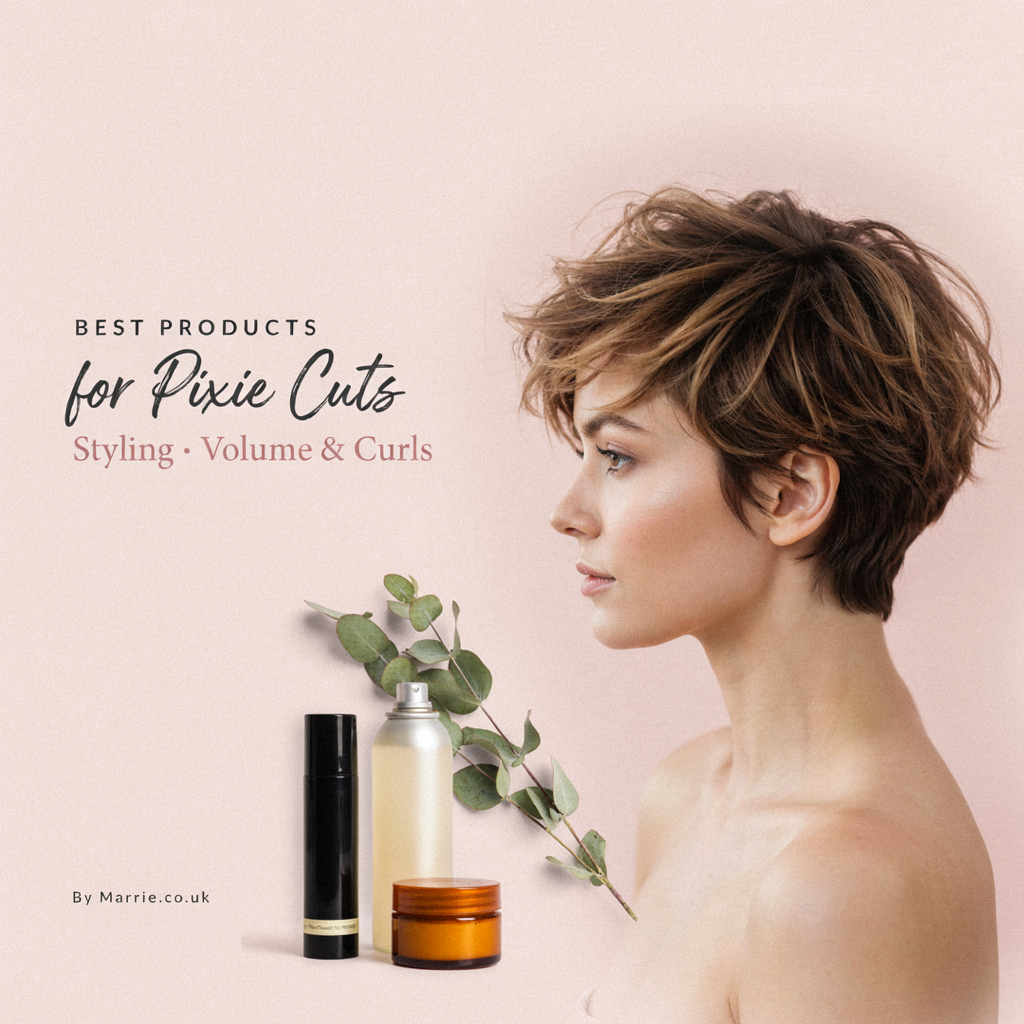
A great pixie cut starts with the haircut itself, but the right products can make a big difference to how easily you style and maintain it.
Because pixie cuts are short, even a small amount of styling product can noticeably change the finished look. A lightweight mousse can add volume to fine hair, curl cream can help define a curly pixie, while a small amount of styling paste can give a textured cut separation and definition.
The challenge is knowing which products your particular pixie actually needs.
In this guide, we’ll look at the best products for pixie cuts, what each type of product does, which hair types they suit and how to avoid weighing short hair down.
If you’re still deciding which pixie style is right for you, start with our complete Short Curly Pixie Hairstyles guide.
What Products Do You Need for a Pixie Cut?
You don’t need a bathroom shelf full of products just because you’ve gone short.
For most pixie cuts, a simple routine is enough:
- Shampoo suitable for your scalp and hair type
- Lightweight conditioner
- One main styling product
- Heat protectant if using heated tools
- Optional finishing product for hold, texture or shine
The right styling product depends on what you’re trying to achieve.
| Your Goal | Product to Consider |
|---|---|
| More volume | Volumising mousse |
| Defined curls | Curl cream or gel |
| Piecey texture | Styling paste |
| Strong definition | Wax or pomade |
| Natural movement | Lightweight styling cream |
| Sleek finish | Smoothing serum |
| Flexible hold | Light hairspray |
| Heat styling | Heat protectant |
| Refreshing curls | Curl refresher |
| Reducing dryness | Lightweight leave-in conditioner |
The important word here is lightweight.
Short hair can quickly become flat, greasy or stiff when too much product is applied.
12 Best Types of Products for Pixie Cuts
1. Lightweight Shampoo
Good styling starts before you reach for mousse or wax.
Choose a shampoo according to your scalp and hair type, rather than simply looking for something labelled for short hair.
If your scalp becomes oily quickly, a gentle cleansing shampoo may help prevent buildup. Dry or curly hair may benefit from a more moisturising formula.
The objective is clean, manageable hair without unnecessarily stripping away moisture.
Best for:
All pixie cuts.
Pixie tip:
Styling products can accumulate quickly on short hair, particularly if you regularly use wax, paste or dry shampoo. Pay attention to buildup and cleanse accordingly.
2. Lightweight Conditioner
Don’t assume short hair doesn’t need conditioner.
Hair can still become dry, frizzy or difficult to manage regardless of length.
The trick is choosing the right amount.
For fine hair, concentrate a lightweight conditioner mainly through the hair rather than loading the roots.
Curly, coily, bleached or particularly dry pixies may need more conditioning.
Best for:
All hair types, especially dry and curly pixies.
3. Volumising Mousse
Mousse is one of the most useful styling products for a pixie when you want volume without excessive weight.
Work a small amount through damp hair, concentrating around the roots and crown.
You can then blow-dry the hair while lifting it away from the scalp.
Mousse works particularly well for:
- Fine pixie cuts
- Flat hair
- Voluminous crowns
- Side-swept pixies
- Wavy pixies
- Longer pixie cuts
If your main concern is creating fullness, also explore our guide to Pixie for Fine Hair.
4. Curl Cream
For a curly pixie, curl cream can help encourage definition while reducing frizz.
The important thing is finding the right weight for your curl pattern.
Loose curls may become flat under a rich cream, whereas tighter or drier curls may benefit from additional moisture.
Start with a small amount and add more only if necessary.
Best for:
Curly and coily pixies.
How to use:
Apply to damp hair, distribute gently and scrunch the curls into their natural shape.
You can then air-dry or use a diffuser.
For more naturally textured haircut ideas, see our Short Curly Pixie Hairstyles guide.
5. Styling Gel
Gel can provide more definition and hold than a curl cream.
It’s particularly useful for:
- Defined curls
- Coily pixies
- Sleek pixies
- Wet-look styles
- Controlling shorter sections
- Styled edges
Some gels dry with a firm cast. On curly hair, that cast can sometimes be gently scrunched once completely dry to reveal softer curls underneath.
Use only as much as your hairstyle requires.
6. Styling Paste
A styling paste is one of my favourite product types for a textured pixie cut.
It can help separate short layers and create that slightly piecey, deliberately undone finish often seen on modern pixies.
Warm a tiny amount between your fingertips before applying it to dry hair.
Concentrate on selected sections rather than coating the entire head.
Best for:
- Choppy pixies
- Textured pixies
- Short layers
- Tousled styles
- Pixies with bangs
For fringe ideas, see our dedicated Pixie with Bangs guide.
7. Hair Wax
Wax can provide stronger definition than many styling creams.
It’s particularly useful when you want to emphasise individual sections, control short pieces or create a more sculpted pixie.
However, wax is easy to overuse.
Fine hair may become flat or greasy if too much is applied.
Best for:
Short, structured and textured pixie cuts.
Marrie tip:
Start with an amount smaller than you think you need. You can always add more.
8. Pomade
Pomade can work particularly well for polished, sleek or vintage-inspired pixies.
Depending on the formula, it can provide definition, shine and control.
It can be useful for:
- Sleek side parts
- Finger-wave-inspired pixies
- Defined short layers
- Controlled fringes
- Polished evening styles
If you have fine hair, choose carefully because heavier pomades can reduce volume.
9. Texturising Spray
Texturising spray can help create movement and separation without requiring heavy wax.
It can be particularly useful for longer or tousled pixies where you want the hair to look relaxed rather than perfectly sculpted.
Apply gradually and work through the hair with your fingers.
Best for:
Straight, wavy and longer pixie cuts.
10. Lightweight Leave-In Conditioner
Curly, coily, coloured and dry pixie cuts may benefit from additional moisture between washes.
A lightweight leave-in conditioner can make the hair easier to manage without requiring a heavy styling cream.
Again, quantity matters.
Because the hair is short, you may need considerably less product than someone with shoulder-length or long hair.
Best for:
Dry, curly, coily or colour-treated pixies.
11. Heat Protectant
If you regularly use a hairdryer, straighteners or other heated styling tools, a heat-protection product is worth incorporating into your routine.
Follow the instructions for the particular product you’re using.
Heat protectant doesn’t mean unlimited heat is harmless, so keep temperatures appropriate for your hair and avoid unnecessary repeated passes with heated tools.
Best for:
Anyone regularly heat-styling their pixie.
12. Lightweight Hairspray
Hairspray can help maintain the final shape once you’ve finished styling.
A flexible or lightweight hold is often enough for everyday pixies.
Stronger hold may be useful for lifted fronts, formal hairstyles or particularly structured cuts.
Spray from an appropriate distance rather than concentrating a large amount on one small section.
Best for:
Finishing and maintaining your hairstyle.
Best Products for Curly Pixie Cuts
Curly pixies usually need a balance between moisture, definition and hold.
A simple routine might include:
Gentle shampoo → conditioner → lightweight leave-in → curl cream or gel
You don’t necessarily need all of them every time.
For example, if your curl cream already provides enough moisture and hold, adding leave-in conditioner and gel as well could simply create unnecessary buildup.
For loose curls
Try:
- Lightweight conditioner
- Light curl cream
- Mousse
- Light-hold gel
For tighter curls
Consider:
- Moisturising conditioner
- Leave-in conditioner
- Curl cream
- Gel for definition
For coily pixies
Moisture retention often becomes particularly important.
Look for a routine that keeps the hair conditioned while allowing the natural coil pattern to remain defined.
Best Products for Fine-Hair Pixies
Fine hair usually needs the opposite approach.
Your biggest enemy may be too much product.
Consider:
- Lightweight shampoo
- Lightweight conditioner
- Volumising mousse
- Root-lifting product
- Light texturising spray
- Flexible hairspray
Be careful with:
- Heavy oils
- Thick butters
- Excessive wax
- Heavy pomades
- Too much dry shampoo
These aren’t necessarily bad products, but they can quickly overpower fine short hair.
For more haircut-specific advice, visit our Pixie for Fine Hair guide.
Best Products for Thick-Hair Pixies
Thick pixies often need help with control, definition and shape rather than extra volume.
Useful products can include:
- Smoothing cream
- Styling cream
- Curl cream for textured hair
- Styling paste
- Pomade
- Flexible hairspray
- Lightweight serum
Don’t automatically choose the strongest product available.
A good haircut should do much of the structural work. Styling products should enhance the shape rather than hold an unsuitable haircut in position.
Our Pixie for Thick Hair guide covers choosing the haircut itself in more detail.
Best Products for Pixies with Bangs
Bangs sit close to your forehead, which makes heavy products particularly noticeable.
For most pixie fringes, less is more.
Depending on your style, consider:
Side-swept bangs: lightweight mousse or styling cream.
Wispy bangs: minimal product and perhaps flexible hairspray.
Choppy bangs: tiny amount of styling paste.
Curly bangs: lightweight curl cream or gel.
Sleek bangs: smoothing product and heat protectant where required.
See our Pixie with Bangs guide for more fringe ideas.
Best Products for Grey or Silver Pixie Hair
Grey hair doesn’t automatically require a completely different styling routine.
Choose products according to how your individual hair behaves.
If it feels dry, additional conditioning may help. If it becomes weighed down easily, use lighter formulas.
Silver and grey hair can also sometimes develop unwanted yellow or brassy-looking tones. Products specifically designed for grey or blonde hair may help manage the appearance of these tones, but follow the manufacturer’s instructions carefully rather than overusing strongly pigmented products.
For more haircut inspiration, see our Pixie for Women Over 50 guide.
Which Styling Product Should You Choose?
Here’s the easiest way to decide.
| If You Want… | Try… |
|---|---|
| More root volume | Mousse |
| Defined curls | Curl cream |
| Stronger curl hold | Gel |
| Piecey texture | Styling paste |
| Strong definition | Wax |
| Sleek polished finish | Pomade |
| Softer control | Styling cream |
| More movement | Texturising spray |
| Shine | Lightweight serum |
| Final hold | Hairspray |
You probably don’t need all ten.
Choose one primary styling product based on the result you want and add another only when there’s a clear reason.
A Simple Pixie Styling Routine
One of the advantages of a pixie is that your routine can remain straightforward.
Step 1: Start with Damp Hair
After washing, gently remove excess water.
Avoid aggressively rubbing curly or fragile hair with a rough towel.
Step 2: Apply Your Main Product
Choose according to your goal.
For example:
Fine hair → mousse
Curly hair → curl cream
Textured pixie → styling cream
Sleek pixie → smoothing product
Step 3: Dry and Shape
Air-dry if your haircut and texture allow.
Alternatively, use a hairdryer or diffuser to direct the hair into shape.
Step 4: Add Definition
Once dry, use a tiny amount of paste, wax or similar finishing product if necessary.
Step 5: Finish
Use hairspray only if your hairstyle needs additional hold.
That’s often all you need.
How Much Product Should You Use on a Pixie?
One of the most common mistakes with short hair is using the same amount of product you used when your hair was long.
Start small.
For concentrated products such as wax or paste, a tiny fingertip amount may be sufficient.
For mousse, curl cream and other products, follow the manufacturer’s directions but begin conservatively until you understand how your hair responds.
If the hair immediately looks greasy, sticky or flat, you’ve probably used too much.
Product Buildup on Short Hair
Short hair doesn’t prevent buildup.
In fact, it can sometimes make buildup more noticeable because styling products are frequently applied close to the roots.
Signs can include:
- Hair becoming unusually flat
- Greasy appearance despite washing
- Dullness
- Curls losing definition
- Hair feeling coated or sticky
- Styling products no longer behaving normally
If you regularly use waxes, sprays, dry shampoo and similar products, make sure your cleansing routine adequately removes them.
Common Pixie Styling Product Mistakes
Using Too Many Products
More products don’t automatically produce a better hairstyle.
Start with one main styling product.
Using Heavy Products on Fine Hair
This can flatten the exact volume you’re trying to create.
Applying Everything at the Roots
Some products work better through the lengths or ends.
Ignoring Your Hair Texture
A product that works brilliantly on straight fine hair may behave completely differently on thick curls.
Using Too Much Wax
Wax should usually provide definition—not make every strand feel coated.
Expecting Products to Fix the Wrong Haircut
If your pixie is constantly difficult to style, the problem may be the shape of the haircut rather than the styling product.
Products vs Tools: What Else Is Useful?
You don’t necessarily need many styling tools either.
A simple pixie kit might contain:
- Hairdryer
- Diffuser for curls
- Small brush or comb
- Wide-tooth comb for some curly textures
- Hair clips for sectioning
- Satin or silk bonnet/pillowcase where appropriate
Small hair accessories can also be useful for longer pixies and styles with bangs.
For example, small clips can hold a growing fringe away from your face or add a decorative detail to a longer pixie.
Choose accessories proportionate to your hairstyle. An extra-large claw clip designed for long, thick hair obviously isn’t appropriate for a very short pixie.
How to Choose Products Without Wasting Money
Before buying another product, ask yourself one question:
What specific problem am I trying to solve?
If the answer is:
“My hair is flat.”
Look for volume.
“My curls are undefined.”
Look for curl definition.
“My layers disappear.”
Look for texture.
“My hair is frizzy.”
Look at moisture, styling technique and smoothing/definition.
“My hairstyle collapses.”
Consider hold.
This is much more useful than buying products simply because they’re trending on social media.
Frequently Asked Questions
What is the best product for a pixie cut?
There isn’t one best product for every pixie. Mousse works well for volume, curl cream for curls, styling paste for texture and pomade for a sleeker finish.
What should I use to style a short pixie cut?
Start with one product suited to your goal. A lightweight styling cream is versatile, while mousse, paste, gel or curl cream may be better for specific styles.
What is the best product for a curly pixie?
A lightweight curl cream or gel can help define curls. The right choice depends on your curl pattern, dryness and desired level of hold.
What products are best for fine pixie hair?
Lightweight volumising mousse, root-lifting products and texturising sprays can help create volume without excessively weighing fine hair down.
What products work well for thick pixie hair?
Styling creams, pastes and smoothing products can help manage thick hair and define the haircut’s shape.
Is mousse good for pixie cuts?
Yes. Mousse can be particularly useful when you want volume and movement without the weight of heavier waxes or creams.
Is wax or gel better for a pixie?
They produce different results. Wax is useful for piecey definition and texture, while gel generally provides stronger hold and can work particularly well for defined curls or sleek styles.
How do I make my pixie look textured?
Apply a small amount of styling paste or texturising product to dry hair and use your fingertips to separate selected sections.
How can I keep my pixie from looking flat?
Consider lightweight volumising products, root lift and drying the crown away from the scalp. The haircut itself also needs appropriate layering for your hair density.
Do pixie cuts need hairspray?
Not always. If your haircut naturally holds its shape, you may not need hairspray. Use it when you want additional hold or need the style to last longer.
Final Thoughts: Keep Your Pixie Routine Simple
Finding the best products for pixie cuts isn’t about owning as many styling products as possible.
It’s about understanding what your particular haircut needs.
Fine pixies may benefit from lightweight volume. Thick pixies often need definition and control. Curly pixies may need moisture and curl definition, while sleek or textured styles require completely different finishing products.
Start with a simple routine and add products only when they solve a genuine styling problem.
And remember: products can enhance a great haircut, but they can’t completely compensate for a pixie that doesn’t work with your natural texture.
If you’re still deciding on your ideal style, visit our Short Curly Pixie Hairstyles: The Ultimate Guide for haircut ideas, face-shape advice, maintenance tips and more inspiration.