
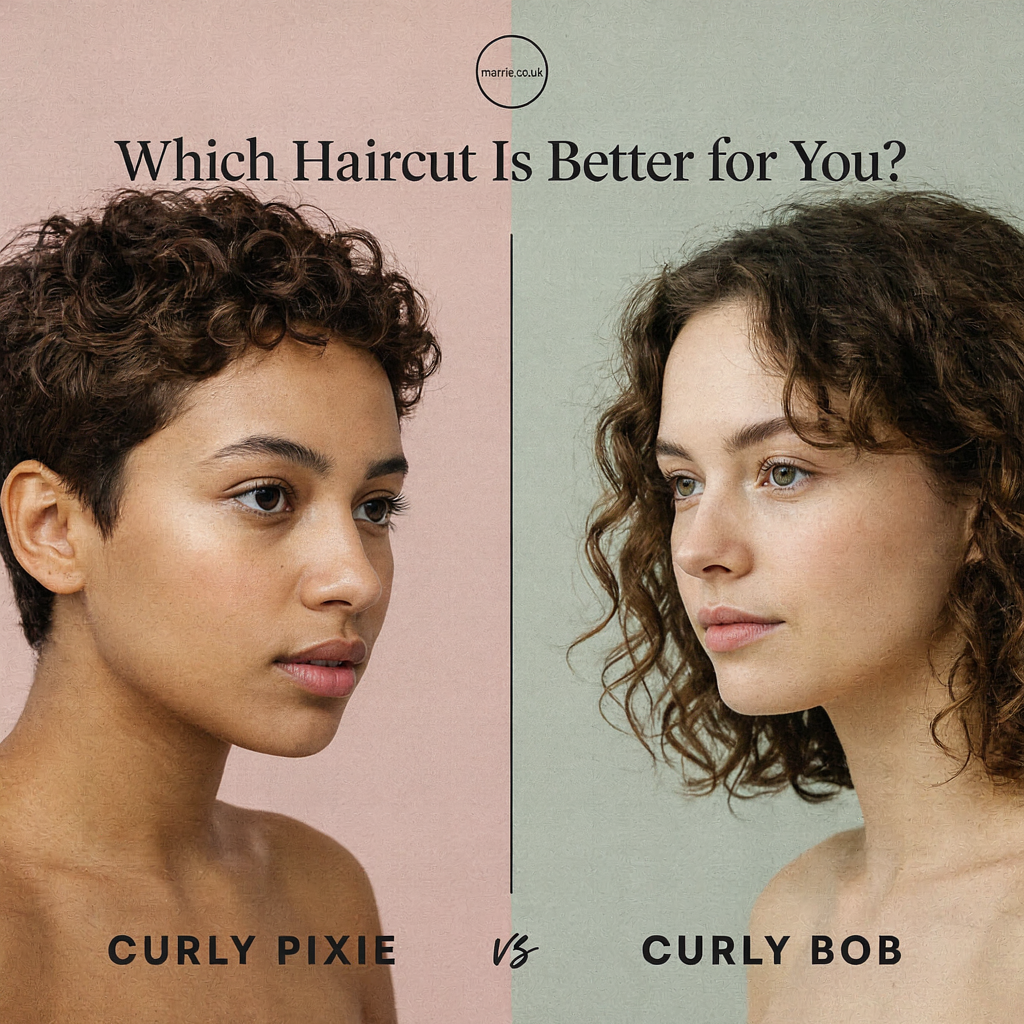
Choosing between a curly pixie and a curly bob can be difficult. Both can showcase natural curls beautifully, both can be adapted to different face shapes, and both offer a dramatic change if you’re moving away from longer hair.
But they don’t behave in the same way.
A curly pixie gives you a shorter, more exposed shape with plenty of opportunities to play with texture through the crown and fringe. A curly bob retains considerably more length, giving your curls more movement and providing more options for tying, pinning and changing your hairstyle.
So, which should you choose?
This curly pixie vs curly bob comparison looks at maintenance, styling, volume, face shape, hair texture, grow-out and everyday practicality to help you decide.
If you’re particularly interested in going shorter, explore our complete Short Curly Pixie Hairstyles guide for more inspiration.
Curly Pixie vs Curly Bob: Quick Comparison
If you’re deciding between the two, start here.
| Feature | Curly Pixie | Curly Bob |
|---|---|---|
| Length | Very short | Usually around jaw to shoulder length |
| Maintenance | Less hair to manage, but shape may need more frequent trims | More hair to manage, but often more forgiving as it grows |
| Styling | Quick once you know your curl routine | More styling possibilities |
| Volume | Easy to concentrate at crown | Can create fuller overall shape |
| Face shape | Adaptable through fringe, taper and volume | Adaptable through length, layers and parting |
| Curl definition | Individual curls can become prominent | More room for complete curl pattern |
| Wash time | Usually quicker | Usually longer |
| Drying time | Usually faster | Usually slower |
| Updos | Limited | More options |
| Growing out | Requires several transitional stages | Generally easier |
| Biggest advantage | Bold, lightweight and distinctive | Versatile and easier to restyle |
| Biggest consideration | Regular reshaping | More hair to wash, dry and manage |
Neither is universally better. The right choice depends on what you want from your hair.
What Is a Curly Pixie Cut?
A curly pixie is a short haircut that keeps enough length for your natural curl pattern to remain visible.
The sides and back may be tapered or closely cropped, while more length is usually retained through the crown, front or fringe.
There are many variations, including:
- Tapered curly pixie
- Long curly pixie
- Curly pixie with bangs
- Tousled pixie
- Voluminous curly pixie
- Pixie with short sides
- Coily pixie
- Side-parted curly pixie
Because so much of the hair is removed, the shape of the haircut becomes particularly important.
For more variations, visit our complete Short Curly Pixie Hairstyles guide.
What Is a Curly Bob?
A curly bob is considerably longer than a traditional pixie.
The hair generally falls somewhere around the jaw, chin or neck, although longer bob variations may approach the shoulders.
A bob can be:
Blunt, creating a stronger outline.
Layered, encouraging movement and reducing bulk.
Graduated, with a shorter back and longer front.
Asymmetrical, with different lengths on either side.
Curly with bangs, adding additional framing around the forehead.
The additional length gives curls more room to form and provides more styling possibilities than a very short pixie.
Curly Pixie vs Curly Bob: Maintenance
This is where the comparison becomes interesting.
You might assume that shorter automatically means lower maintenance.
That’s only partly true.
Curly Pixie Maintenance
A pixie gives you much less hair to wash, condition and dry.
Your everyday routine may therefore become considerably quicker.
However, because the haircut relies heavily on its shape, new growth can become noticeable relatively quickly.
If the sides are tapered or the nape is closely shaped, you may want regular salon appointments to maintain the original silhouette.
Curly pixie maintenance may involve:
- Faster washing
- Faster drying
- Less product
- Quick morning refreshes
- More frequent shape maintenance
- Regular attention to the sides and nape
Curly Bob Maintenance
A curly bob requires more hair care simply because there’s more hair.
Washing, conditioning, detangling and drying may take longer.
On the other hand, a bob can often tolerate more growth before it looks noticeably different.
Curly bob maintenance may involve:
- Longer wash routine
- More conditioner/styling product
- Longer drying time
- Less frequent reshaping depending on the cut
- More detangling
- More options when the curls aren’t cooperating
Winner for everyday speed: Curly Pixie
Winner for fewer shape-conscious salon visits: Often the Curly Bob
Curly Pixie vs Curly Bob: Styling
Your lifestyle should strongly influence this decision.
Styling a Curly Pixie
Pixie styling tends to focus on:
- Curl definition
- Crown volume
- Fringe placement
- Side control
- Texture
- Parting
You have less hair, so styling can be fast.
The trade-off is that you can’t simply tie everything into a ponytail when you don’t feel like styling it.
A badly behaved section can also be more noticeable because there is less hair available to disguise it.
If you choose a pixie, our How to Style a Curly Pixie Cut at Home guide walks through the complete routine.
Styling a Curly Bob
A bob provides considerably more flexibility.
Depending on length, you may be able to:
- Wear it naturally curly
- Create a side part
- Create a centre part
- Pin back one side
- Wear a headband
- Create half-up styles
- Use decorative clips
- Create small twists
- Tie some or all of the hair back
This makes the curly bob particularly attractive if you enjoy changing your hairstyle.
Winner for speed: Curly Pixie
Winner for versatility: Curly Bob
Curly Pixie vs Curly Bob: Volume
Both haircuts can create fantastic volume—but in different places.
Volume with a Curly Pixie
Removing length reduces weight.
For some curl patterns, that allows the hair to spring upwards and create impressive crown volume.
A pixie can therefore work particularly well if you like:
Height + texture + defined curls on top.
Keeping the sides more controlled can make the crown appear even fuller.
Volume with a Curly Bob
A curly bob creates a larger overall silhouette.
Instead of concentrating most of the volume through the crown, the curls can create fullness around the sides, jaw and lower sections.
Layers can be used to distribute that volume.
Choose a pixie if:
You like height and concentrated crown volume.
Choose a bob if:
You like fuller curls throughout the hairstyle.
Curly Pixie vs Curly Bob: Which Is Best for Your Face Shape?
There’s no face shape that automatically rules out either haircut.
The better question is:
How should the haircut be adapted to your face?
| Face Shape | Curly Pixie | Curly Bob |
|---|---|---|
| Round | Crown height and controlled sides can create length | Longer bob and strategic layers can frame the face |
| Oval | Most pixie shapes can work | Most bob lengths can work |
| Square | Softer curls and fringe can soften the outline | Curved layers around jaw can create softness |
| Heart | Curly fringe and moderate crown volume | Chin-area volume can balance proportions |
| Long | Avoid excessive crown height if undesired | Chin-length fullness can visually add width |
These are styling ideas rather than rules.
If you’re specifically choosing a pixie, see our guides to Pixie for Round Faces and Pixie for Oval Faces.
Curly Pixie vs Curly Bob for Fine Hair
Fine curly hair presents an interesting choice.
A pixie removes length and weight, which can sometimes make the hair easier to lift at the roots.
Strategic short layers can create the appearance of additional body.
However, overly aggressive layering can make low-density hair appear thinner.
A bob retains more hair and can create the appearance of fullness around the perimeter, particularly when the ends aren’t excessively thinned.
Consider a curly pixie if:
You want root lift, less weight and a shorter styling routine.
Consider a curly bob if:
You want to retain more visible density and prefer a fuller outline.
Our Pixie for Fine Hair guide explores the shorter option in greater detail.
Curly Pixie vs Curly Bob for Thick Hair
Thick curly hair can work beautifully with either.
With a pixie, the stylist can remove substantial length and create a lighter shape while retaining curls through the top.
This can dramatically reduce the amount of hair you need to wash and dry.
A curly bob preserves more of your natural volume and gives the curls greater room to move.
However, poorly placed layers can sometimes create unwanted width.
Consider a pixie if:
You’re tired of managing large amounts of thick hair and want something lighter.
Consider a bob if:
You love your natural fullness and don’t want to lose too much length.
See our Pixie for Thick Hair guide for more advice.
Curly Pixie vs Curly Bob for Tight Curls and Coils
Shrinkage becomes especially important here.
A haircut that appears considerably longer when wet may spring upwards once dry.
For a pixie, this can create beautiful height and definition, but the stylist needs to understand how your curl pattern behaves.
With a bob, shrinkage influences where the finished perimeter sits.
A bob intended to finish around the chin, for example, needs to account for how much the curls contract after drying.
If possible, choose a stylist experienced with your particular curl pattern.
Which Haircut Uses Less Product?
Usually the curly pixie.
There is simply less hair.
You may need only a small amount of:
- Leave-in conditioner
- Curl cream
- Mousse
- Gel
But don’t assume short curls require no product.
Depending on your texture, moisture and hold can still be important.
If you’re unsure what you actually need, see our Best Products for Pixie Cuts guide.
Which Is Easier in the Morning?
This depends on what happened overnight.
A pixie can be extremely fast to refresh.
Mist flattened areas with water, reshape a few curls, diffuse briefly and you’re ready.
But short curls can also become noticeably flattened against the pillow.
A bob may require more overall refreshing, but longer sections can sometimes be rearranged, pinned or tied when you don’t want to completely restyle them.
If speed matters most:
The pixie probably has the advantage.
If flexibility matters most:
The bob probably wins.
Curly Pixie vs Curly Bob with Bangs
Both work beautifully with bangs.
Curly Pixie with Bangs
The fringe becomes a major feature because the rest of the haircut is so short.
You could choose:
- Short curly bangs
- Wispy bangs
- Side-swept fringe
- Longer curly fringe
- Asymmetrical bangs
Curly Bob with Bangs
A bob allows the fringe to blend into longer layers.
You could choose:
- Full curly fringe
- Curtain-style curly bangs
- Side bangs
- Wispy fringe
- Longer face-framing pieces
If you’re leaning towards the shorter option, see our Pixie with Bangs guide.
Which Haircut Is Better for Hot Weather?
A pixie removes considerably more hair from the neck and sides.
For someone who finds thick or long curls uncomfortable during warm weather, this can feel much lighter.
A bob retains more hair around the neck.
However, depending on its length, you may have the option to tie or clip some of it away.
Which Haircut Is Better for Exercise?
This comes down to preference.
A pixie eliminates the need for a ponytail, but sweat can alter the shape of your curls.
You may need to refresh the front or crown afterwards.
A sufficiently long bob can potentially be tied or clipped back during exercise.
If your bob is too short for a ponytail, a headband or small clips can help keep the hair away from your face.
Which Is Easier to Grow Out?
Generally, the curly bob.
Growing a bob longer is relatively straightforward because you’re already working with more length.
Growing out a pixie involves several stages:
Short pixie → grown-out pixie → bixie → short bob → bob.
That doesn’t mean the process has to look awkward.
Regular shaping can help maintain an intentional hairstyle while the length increases.
But if you frequently switch between short and long hair, consider whether you’re comfortable with the grow-out process before committing to an ultra-short pixie.
Which Is the Bigger Transformation?
The pixie.
If you’re cutting long curly hair into a pixie, the change can be dramatic.
Your:
- Face
- Neck
- Ears
- Hairline
- Jewellery
- Makeup
may all become more visually prominent because there is less hair surrounding them.
A curly bob can still be a major transformation, but retaining length around the face often makes it feel like a gentler transition.
Should You Choose a Pixie If You’ve Never Had Short Hair?
You certainly can.
But if you’re nervous, a curly bob can act as an intermediate step.
For example:
Long curls → curly bob → long pixie → shorter pixie
This allows you to discover how you feel about progressively shorter hair.
Alternatively, if you’ve wanted a pixie for years and are comfortable with a dramatic change, there’s no requirement to transition gradually.
Curly Pixie vs Curly Bob: Lifestyle Comparison
Think about your normal week rather than just your ideal salon photograph.
| Lifestyle Priority | Better Starting Point |
|---|---|
| Fast washing | Pixie |
| Fast drying | Pixie |
| Minimal hair around neck | Pixie |
| Frequent hairstyle changes | Bob |
| Ponytails/half-up styles | Bob |
| Bold transformation | Pixie |
| Easier grow-out | Bob |
| Showing natural crown curls | Pixie |
| Keeping more length | Bob |
| Hair accessories | Bob |
| Regular salon shaping isn’t a problem | Pixie |
| Nervous about going very short | Bob |
Pros and Cons of a Curly Pixie
Advantages
A curly pixie can feel light, fresh and distinctive. It uses less product, usually dries faster and can showcase individual curls beautifully.
It can also put greater emphasis on your facial features.
Things to Consider
The shape may need regular maintenance.
You also lose many of the practical styling options associated with longer hair.
And if you decide to grow it out, you’ll need patience through several different lengths.
Pros and Cons of a Curly Bob
Advantages
A curly bob provides more styling versatility while still removing a significant amount of length.
You can experiment with accessories, parts, bangs, half-up styles and different curl arrangements.
Growing it longer is also relatively straightforward.
Things to Consider
More hair means more washing, conditioning, detangling and drying.
Thick curly bobs may also become bulky if the shape and layers aren’t properly designed.
Curly Pixie or Curly Bob? Ask Yourself These 7 Questions
Before making the appointment, ask yourself:
- How short am I genuinely comfortable going?
- Do I regularly tie my hair back?
- How much time do I want to spend drying my curls?
- Am I happy having regular trims?
- Do I enjoy changing my hairstyle frequently?
- How does my natural curl pattern behave when short?
- Am I choosing the haircut because I genuinely want it—or just because I like one particular photograph?
Your answers will probably make the decision considerably easier.
What to Ask Your Hairdresser
Whether you choose a pixie or bob, bring several inspiration photographs.
Ask your stylist:
How will this work with my curl pattern?
Where will my hair sit once it dries and shrinks?
Will I need layers?
Where should the volume be concentrated?
How often will the shape need trimming?
How can I recreate this at home?
How will the haircut grow out?
A consultation is particularly important when making a major length change.
Frequently Asked Questions
Is a curly pixie easier to maintain than a curly bob?
A pixie usually requires less washing, drying and product, but the haircut’s shape may need more frequent salon maintenance. A bob takes longer to manage day-to-day but can be more forgiving as it grows.
Is a curly pixie or curly bob better for round faces?
Both can work. A pixie can use crown height and controlled sides to create a more elongated silhouette, while a bob can use length and strategic layering to frame the face.
Which is better for fine curly hair?
Both are possibilities. A pixie can remove weight and encourage lift, while a bob can preserve more visible density around the perimeter.
Which is better for thick curly hair?
A pixie can dramatically reduce bulk and drying time. A bob retains more natural fullness and provides greater styling versatility.
Is a curly pixie difficult to style?
It doesn’t have to be. Once you understand how your curls behave at short lengths, a simple routine involving moisture, definition and careful drying may be enough.
Does curly hair get curlier when cut into a pixie?
Sometimes removing length and weight allows curls to spring up more strongly, but everyone’s hair behaves differently. Your curl pattern may also appear different at shorter lengths.
Is a bob safer if I’m nervous about short hair?
It can be. A bob allows you to experience shorter hair without immediately committing to an ultra-short cut.
Which haircut requires more styling products?
Usually a bob simply because there is more hair, although the exact amount depends on texture and styling routine.
Can you grow a pixie into a curly bob?
Yes. The hair will gradually move through longer pixie and bixie stages before reaching bob length. Occasional shaping can make the transition look more intentional.
Which haircut is more versatile?
Generally, a curly bob provides more styling options because you have more length to work with.
Curly Pixie vs Curly Bob: The Verdict
So, which wins the curly pixie vs curly bob comparison?
Neither—and that’s the point.
Choose a curly pixie if you want a bold shorter look, quicker washing and drying, less hair to manage and the opportunity to make your natural texture a prominent feature.
Choose a curly bob if you want to retain more length, enjoy changing your hairstyle, regularly use hair accessories or want an easier route back to longer hair.
And if you’re somewhere in the middle, consider a long curly pixie or bixie.
The most important factor isn’t which haircut is supposedly “best.” It’s which one works with your curl pattern, lifestyle, styling habits and willingness to maintain it.
If the pixie is winning you over, continue to our complete Short Curly Pixie Hairstyles: The Ultimate Guide for more styles, face-shape advice, maintenance tips and curly pixie inspiration.